Flat vs Round Submersible Pump Cable: Which One Should You Choose?
Flat and round submersible cables use the same core ingredients but suit different installations. Here is how to decide which shape is right for your well, pump and fittings.
Walk into any electrical market in Pakistan and ask for submersible pump cable, and one of the first questions you will hear is: flat or round? Both types power millions of pumps, both use copper conductors and PVC insulation, and both can last for years when installed properly. The right choice depends on your well, your pump and how the cable will be handled.
This article compares the two side by side so you can make a confident decision.
The short answer
- Choose flat cable when space in the borehole is tight, when you want the cable to lie neatly against the riser pipe, or when your installer is used to strapping flat cable.
- Choose round cable when the cable must pass through a gland or fitting, when you want equal protection on all sides, or when the run at the surface is exposed to handling and abrasion.
Now let us look at why.
How the two designs differ
Flat cable construction
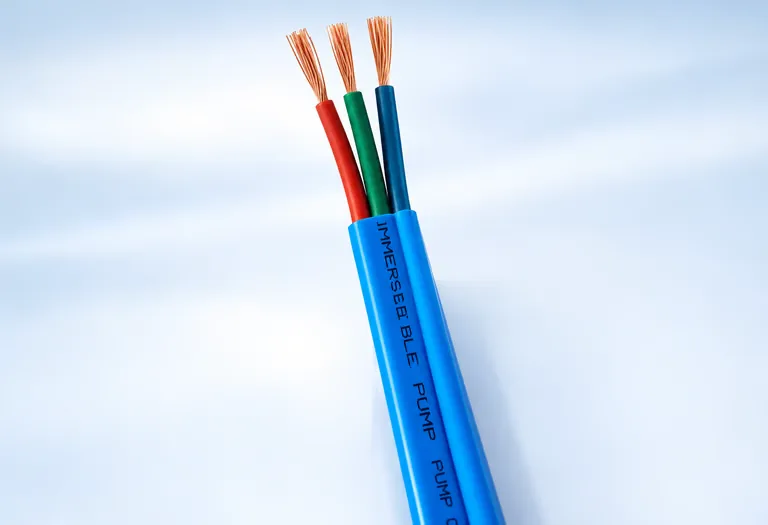
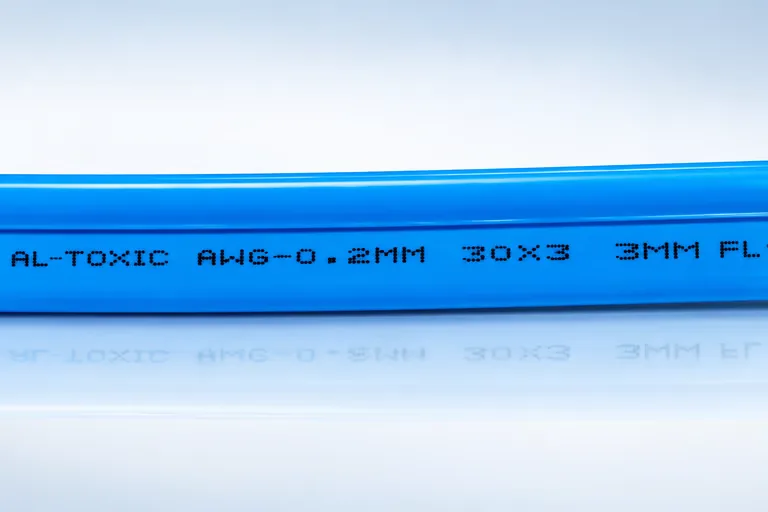
In a flat submersible pump cable the insulated cores are laid side by side and enclosed in a flat outer sheath. The result is a slim ribbon-like profile. Because the cores are parallel and not twisted together, the cable lies flat against the pipe and can be strapped tidily.
Round cable construction
In a round submersible pump cable the insulated cores are bundled together, often with fillers, and enclosed in a circular sheath. The round form distributes protection evenly around every core.
Comparison by factor
1. Space in the borehole
The space between the riser pipe and the borehole wall is limited, especially in smaller-diameter bores. A flat cable occupies less of this gap, reducing the chance of the cable being pinched or scraped as the pump is lowered. Advantage: flat.
2. Sealing and glands
Where the cable enters a control panel, junction box or well cap through a gland, a round cross-section seals far more reliably. Sealing a flat cable usually needs special fittings or a transition joint. Advantage: round.
3. Mechanical protection
Round cable protects all cores equally, which is helpful where the cable is dragged, stepped on or exposed at the surface. Flat cable has thinner edges, so it deserves extra care against sharp edges at the well head. Advantage: round.
4. Heat dissipation
Because flat cable spreads its cores out, it presents more surface area for heat to escape. In practice, correct sizing matters far more than shape, but flat geometry is a small plus for heat. Slight advantage: flat.
5. Flexibility and handling
Both cables use stranded copper and are flexible. Flat cable bends easily across its flat face but resists bending edgeways; round cable bends evenly in every direction. Installers often find flat cable easier to reel and strap, and round cable easier to route around corners. Tie — depends on the job.
6. Jointing
Splicing the cable to the pump motor lead is a critical step. Many motor leads are flat, so a flat supply cable can simplify the joint. Round cable joints are equally reliable with the correct splice kit. Slight advantage: flat, for many pump motors.
Quick comparison
- Narrow borehole / tube well: flat usually preferred
- Gland entry into panel: round usually preferred
- Surface run exposed to abrasion: round usually preferred
- Neat strapping to riser pipe: flat usually preferred
- Current capacity: equal for the same conductor size and quality
What stays the same
Whichever shape you choose, the fundamentals do not change:
- Copper quality determines conductivity and efficiency. Read why copper conductors matter.
- Insulation quality keeps water away from the conductor. Look for a manufacturer that spark tests its cable — see what is spark testing.
- Correct sizing prevents voltage drop and overheating. Our cable size guide explains the basics.
- Careful installation protects the sheath and joints.
Real-world scenarios
Agricultural tube well
A typical farm tube well has a steel or PVC casing, a riser pipe and a pump set well below the water table. Space around the riser is limited and the cable must be strapped every few metres. Here a flat cable is usually the practical choice: it hugs the pipe, is less likely to snag on casing joints, and is quick to strap during installation and pump pulls.
Domestic boring
In homes and housing societies the borehole is often smaller and the cable run to the panel may pass through walls or conduits. Flat cable suits the bore itself, while the surface section is often protected in conduit. If the panel uses round glands, plan a proper transition joint or choose round cable for that section.
Commercial and industrial pumping
Factories and commercial buildings often have formal panels with glanded entries and cable trays. Round cable fits this environment naturally and presents a neat, well-sealed installation. Where the pump is in a narrow bore, installers may still prefer flat cable down the well.
Common mistakes to avoid
- Choosing by shape instead of size. A thin cable in either shape will struggle on a long run.
- Forcing flat cable through round glands. This rarely seals well and can let moisture into the panel.
- Ignoring the surface run. The metres between the well head and the panel are often where damage happens.
- Mixing cable types in one run without a proper joint. Every joint is a potential weak point; make each one carefully.
Our recommendation
For most tube well and deep well installations with a standard riser pipe, flat cable is a practical, space-saving choice. For installations where the cable runs through glands, conduits or exposed areas, round cable offers easier sealing and balanced protection. If you are unsure, share your borehole diameter, pump details and cable length with us — we are happy to help.
Frequently asked questions
Is flat submersible cable weaker than round cable?
Not inherently. A well-made flat cable and a well-made round cable of the same conductor size carry the same current. The difference is mainly shape, space and how it fits your installation.
Which cable is better for a narrow borehole?
Flat cable is usually preferred in narrow boreholes because it lies close to the riser pipe and takes up less of the annular space.
Which is easier to seal through a cable gland?
Round cable, because standard cable glands are designed to grip and seal around a circular cross-section.
Does cable shape change the size I need?
No. Conductor size is chosen from motor current, voltage and cable length. Shape is a separate decision about fit and handling.
- #flat submersible cable
- #round submersible cable
- #comparison
- #borehole
Related articles
Buying Guides
Complete Guide to Submersible Pump Cables
Everything pump owners, installers and dealers need to know about submersible pump cables — how they are built, flat vs round designs, sizing basics, quality checks and how to make them last.
5 min read
Buying Guides
How to Select the Right Submersible Cable Size for Your Pump
Undersized cable is one of the most common causes of burnt pump motors. Learn how motor current, voltage and cable length decide the right submersible cable size — and why you should confirm it with an electrician.
5 min read
Installation & Maintenance
Installation & Maintenance Tips to Extend Submersible Cable Life
Most submersible cable failures start with handling and installation. Follow these practical tips — from unreeling and jointing to insulation checks — to keep your pump cable working for years.
5 min read