
How to Select the Right Submersible Cable Size for Your Pump
Undersized cable is one of the most common causes of burnt pump motors. Learn how motor current, voltage and cable length decide the right submersible cable size — and why you should confirm it with an electrician.
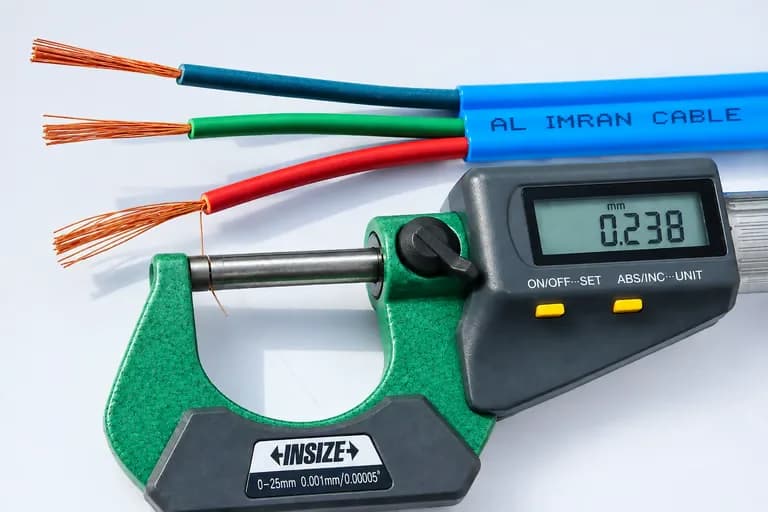
If you ask pump repair workshops why motors burn out, one answer comes up again and again: the cable was too small. Choosing the right submersible cable size is not complicated, but it does require a few facts about your pump and installation. This guide explains the principles so you can have an informed conversation with your electrician or supplier.
Why cable size matters
Every conductor has electrical resistance. When current flows through it, some voltage is "used up" along the way — this is called voltage drop. The longer the cable and the higher the current, the bigger the drop. A thicker conductor has lower resistance, so it drops less voltage.
When voltage drop is too high:
- The motor receives less than its rated voltage.
- To deliver the same power, it draws more current.
- Higher current means more heat in the motor windings and the cable.
- Starting becomes harder, protection may trip, and motor life is shortened.
In other words, an undersized cable quietly wastes energy every hour the pump runs and puts the motor at risk.
The information you need
Before sizing a cable, collect these details:
- Motor full-load current (amps) — printed on the pump or motor nameplate.
- Supply voltage and phase — typically single-phase or three-phase supply.
- Total cable length — from the control panel to the motor. Add the horizontal run at the surface to the pump setting depth, plus a small allowance for connections.
- Starting method — direct-on-line, star-delta or soft starter/VFD, as starting currents differ.
- Ambient and installation conditions — for example, cable exposed to sun at the surface, or bundled with other cables.
Understanding voltage drop
For a simple estimate, electricians use formulas based on conductor resistance.
For a single-phase circuit, the approximate voltage drop is:
Voltage drop ≈ 2 × current × cable length × resistance per metre
The factor of 2 accounts for current travelling down to the motor and back.
For a three-phase circuit, the approximate voltage drop is:
Voltage drop ≈ 1.732 × current × cable length × resistance per metre
Resistance per metre depends on conductor size and material; manufacturers and electrical handbooks publish these values. More detailed calculations also consider power factor, reactance and conductor temperature.
The result is usually expressed as a percentage of supply voltage. Many installation practices aim to keep voltage drop within a small percentage — commonly quoted limits are in the region of 3–5% — but the applicable limit depends on the regulations and the pump manufacturer's requirements, so confirm it for your project.
A simple worked illustration
Consider a hypothetical three-phase pump drawing 10 A with a total cable length of 150 m. If the chosen conductor had a resistance of 0.005 Ω per metre, the estimated drop would be about 1.732 × 10 × 150 × 0.005 ≈ 13 V. On a 400 V supply that is roughly 3.2%. Doubling the cable length would double the drop. These numbers are illustrative only — use actual resistance values for the cable you are considering.
Rules of thumb
- Longer runs need bigger cable. Deep settings and long surface runs quickly add up.
- Size for the motor, not the budget. The small saving on thinner cable is often lost in energy costs and repairs.
- Consider future changes. If you may lower the pump or install a larger motor later, a slightly bigger cable gives headroom.
- Match all cores. Every conductor in the run must be adequately sized.
- Check the joints. A perfectly sized cable with a poor splice still creates a hot spot.
Common sizing mistakes
Using well depth instead of total length
The surface run from the tube well to the panel room can be long. Always measure the full route.
Ignoring starting current
Motors draw several times their running current when starting. A cable that barely copes with running current may cause a large voltage dip at start-up, making starting difficult.
Reusing old cable on a new pump
A replacement pump may draw more current than the old one. Re-check the size whenever the pump changes.
Mixing sizes in one run
Joining a thinner section to a thicker one creates a bottleneck. The thinnest section sets the limit.
Copper quality and sizing
Sizing tables assume a conductor with the expected conductivity. Copper of poor purity has higher resistance, which effectively behaves like a smaller cable. That is why copper conductor quality is just as important as the nominal size printed on the sheath.
Flat or round — does it change the size?
No. The size calculation is the same for flat and round cable. Shape is chosen for fit and handling, as explained in our flat vs round comparison.
Checklist before you buy
- Motor current, voltage and phase noted from the nameplate
- Total cable length measured from panel to motor
- Voltage drop estimated and checked against the applicable limit
- Starting method considered
- Size confirmed by a qualified electrician
- Enough length ordered for connections and future adjustment
Frequently asked questions
What happens if my submersible cable is too small?
The motor receives lower voltage because of voltage drop, draws more current, runs hotter and may trip or burn out. The cable itself can also overheat.
Is well depth the same as cable length?
No. Cable length is the full distance from the control panel to the pump motor — the surface run plus the depth at which the pump is set, plus some allowance for connections.
Can I use a bigger cable than needed?
Yes. A larger conductor reduces voltage drop and runs cooler; the main trade-off is higher cost and weight. Your electrician can find the sensible balance.
Pump ki cable ka size kaise nikaalein?
Motor ka current (amps), supply voltage aur panel se pump tak kul lambai note karein. Inhi se voltage drop calculate hota hai. Final size hamesha kisi qualified electrician se confirm karwayein.
- #cable size
- #voltage drop
- #submersible pump
- #tube well
- #electrician
Related articles
Buying Guides
Complete Guide to Submersible Pump Cables
Everything pump owners, installers and dealers need to know about submersible pump cables — how they are built, flat vs round designs, sizing basics, quality checks and how to make them last.
5 min read
Buying Guides
Flat vs Round Submersible Pump Cable: Which One Should You Choose?
Flat and round submersible cables use the same core ingredients but suit different installations. Here is how to decide which shape is right for your well, pump and fittings.
5 min read
Installation & Maintenance
Installation & Maintenance Tips to Extend Submersible Cable Life
Most submersible cable failures start with handling and installation. Follow these practical tips — from unreeling and jointing to insulation checks — to keep your pump cable working for years.
5 min read